
ACS Publications Industry Webinar
Decoding SEI Dynamics for Long-Life Lithium-Metal Batteries
On-Demand
The cycling stability of lithium-metal batteries—the dependence on charge/discharge rates and the resulting interfacial behavior—is central to their development for electric vehicles and beyond. While lithium metal offers unparalleled energy density, achieving long cycle life has remained a critical challenge. This webinar introduces a mechanistic framework showing how carefully optimized charge/discharge conditions can fundamentally improve performance and safety in Li-metal batteries.
This unified framework provides new insights into cycling strategies for Li-metal batteries, including the use of intermittent pulse discharge protocols that emulate real-world EV applications. It simplifies the interpretation of charge/discharge tradeoffs, supports practical cell design, and offers pathways to extend battery lifespan without sacrificing energy density.
Multiple webinar sessions are available, each led individually by guest speakers Dr. Wurigumula Bao (University of Chicago) and Dr. Yunya Zhang (SES AI). In their sessions, they will review examples across different charge/discharge regimes, highlight the quantitative linkage among SEI conductivity, lithium morphology, and electrochemical performance, and discuss the limitations and open questions shaping the future of Li-metal battery commercialization.
Register to watch the webinars on demand.
SESSIONS & SPEAKERS

Monday, September 29, 2025, 11 a.m. CST (Beijing)
Yunya Zhang, PhD
Director, SES AI
Yunya Zhang earned his B.E. and M.E. in Materials Science and Engineering from Central South University in China. Later, he pursued a Ph.D. in Mechanical and Aerospace Engineering at the University of Virginia, where he focused on nanomaterials for advanced energy storage. He then joined Argonne National Laboratory as a Postdoctoral Appointee, working in the Interfacial Chemistry Group to understand degradation mechanisms of silicon anodes and high-Ni cathodes in Li-ion batteries. In 2021, Yunya moved to SES AI, where he has since advanced through roles from Senior Scientist to Director. At SES, he leads efforts in mechanistic understanding, post-analysis, and materials characterization to improve Li-metal battery performance and enable commercialization in electric vehicles. His work has been recognized through numerous publications, patents, and awards, with a strong emphasis on interfacial stabilization, failure mechanism analysis, and the development of next-generation energy storage technologies.

Thursday, October 2, 2025, 9 a.m. PT
Wurigumula Bao, PhD
Project Scientist, University of Chicago
Wurigumula Bao earned her B.S. in Environmental Engineering from the Beijing Institute of Technology, where she also completed her Ph.D. in Environmental Engineering with a focus on advanced anode materials. She then pursued postdoctoral research at UC San Diego, developing quantitative methodologies to study reaction mechanisms in anode materials and their interphases. In 2022, she joined the University of Chicago’s Pritzker School of Molecular Engineering as a Project Scientist, where she investigates degradation mechanisms in rechargeable batteries and develops standardized methodologies for lithium inventory quantification and battery safety evaluation. Dr. Bao has delivered numerous invited talks at international conferences and published extensively in leading journals such as Nature Energy, Energy & Environmental Science, and ACS Energy Letters. Her research centers on advancing metrology to quantify lithium inventory, probe interphase chemistry, and analyze degradation mechanisms, aiming to accelerate the development of next-generation energy storage technologies.
RESEARCH SPOTLIGHT
ACS Energy Letters 2025, 10, 2, 872–880
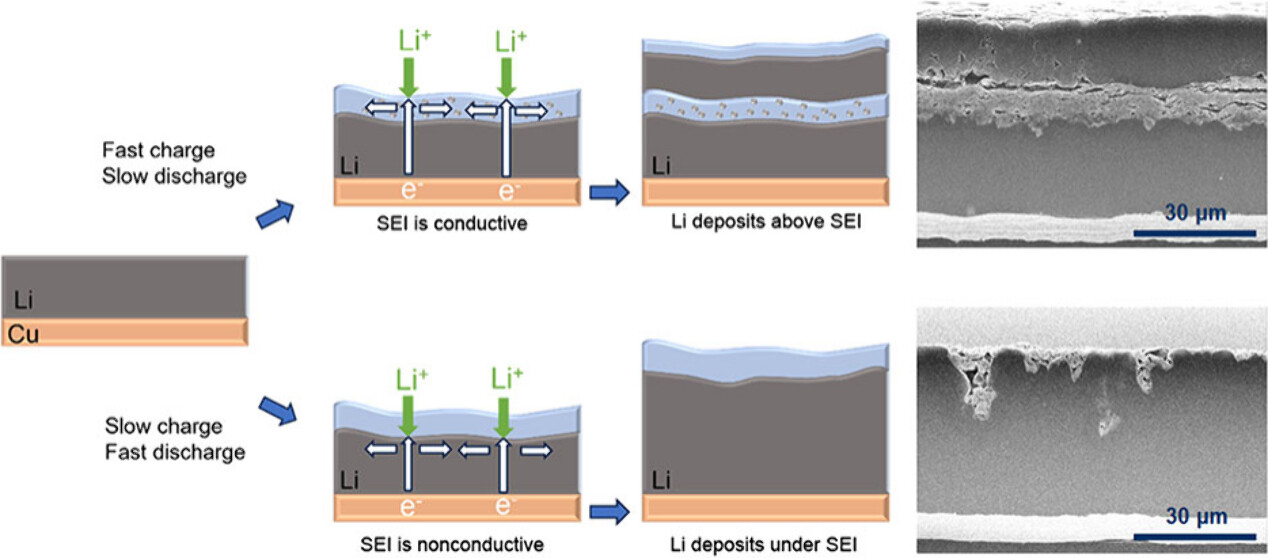
Lithium metal batteries (LMBs) offer superior energy density and power capability but face challenges in cycle stability and safety. This study introduces a strategic approach to improving LMB cycle stability by optimizing charge/discharge rates. Our results show that slow charging (0.2C) and fast discharging (3C) significantly improve performance, with a multilayer LMB retaining over 80% capacity after 1000 cycles. Fast discharge rates promote lithium plating beneath the SEI layer, suppressing its growth and improving Coulombic efficiency, whereas slow discharge rates facilitate lithium plating above the SEI, leading to SEI accumulation. We propose a rational hypothesis linking SEI conductivity and cycling conditions and introduce an intermittent pulse discharge protocol to emulate electric vehicle applications, further improving the stability. These optimized cycling strategies enhance the LMB lifespan, utility, and safety, paving the way for broader market adoption in the years ahead.


Copyright © 2026 | American Chemical Society | 1155 Sixteenth Street NW | Washington, DC 20036
